01
NextG & O-RAN
Network slicing, admission control, and multi-agent resource orchestration for ultra-reliable low-latency 5G and 6G open radio access networks.
Secure, resilient, and intelligent next-generation networks.
The Cyber Resilient Networks (CyReN) Lab develops the theory and systems that keep next-generation networks connected, secure, and intelligent under stress, attack, and uncertainty. Our work spans 5G and 6G open radio access networks, zero trust security, autonomous aerial systems, and AI-driven network management for mission-critical applications.
Network slicing, admission control, and multi-agent resource orchestration for ultra-reliable low-latency 5G and 6G open radio access networks.
Zero trust architectures, cyber risk quantification, and supply chain risk analysis that keep untrusted infrastructure trustworthy.
Distributed orchestration of UAV and robotic networks for coverage, connectivity, and resilient service in contested environments.
Reinforcement learning, agentic AI, and large language model methods for autonomous network management and orchestration.
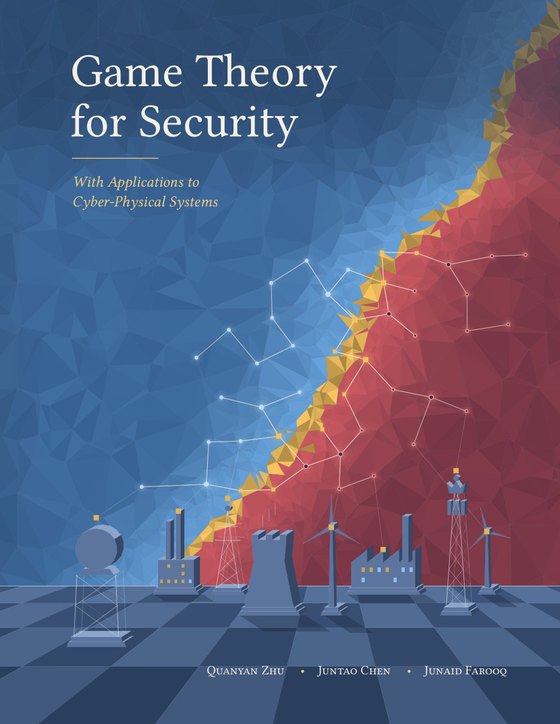 Nov 2026 New book forthcoming with Cambridge University Press: "Game Theory for Security: With Applications to Cyber-Physical Systems," with Quanyan Zhu and Juntao Chen. A graduate text and research reference on the strategic modeling of attack and defense in cyber-physical systems, accompanied by 128 Python scripts that reproduce the worked examples. To appear 2027.
 Sep 2026 Our paper "Adaptive Zero-Trust Microsegmentation via Graph-Aware Learning for Wireless Networks" was accepted in the IEEE CNS Cyber Resilience Workshop (CRW 2026), Newark, Delaware. Congratulations Yuhui and Xingqi!
 Dec 2026 Our paper "Balancing Security and Performance in Spatial Wireless Networks through Software Diversity for Attack Propagation Control" was accepted in the IEEE Global Communications Conference (GLOBECOM 2026), Macau, China. Congratulations Xingqi and Yuhui!
 Sep 2026 Our paper "Performative Security Games: Strategic Manipulation of Decision-Dependent Distributions in Learning-Based O-RAN Control" was accepted in the Conference on Decision and Game Theory for Security (GameSec 2026). Congratulations Xingqi!
We are looking for motivated Ph.D. and master's students interested in NextG networks, cyber resilience, and autonomous systems. Reach out with a CV and a short note on your interests.
mjfarooq@umich.edu